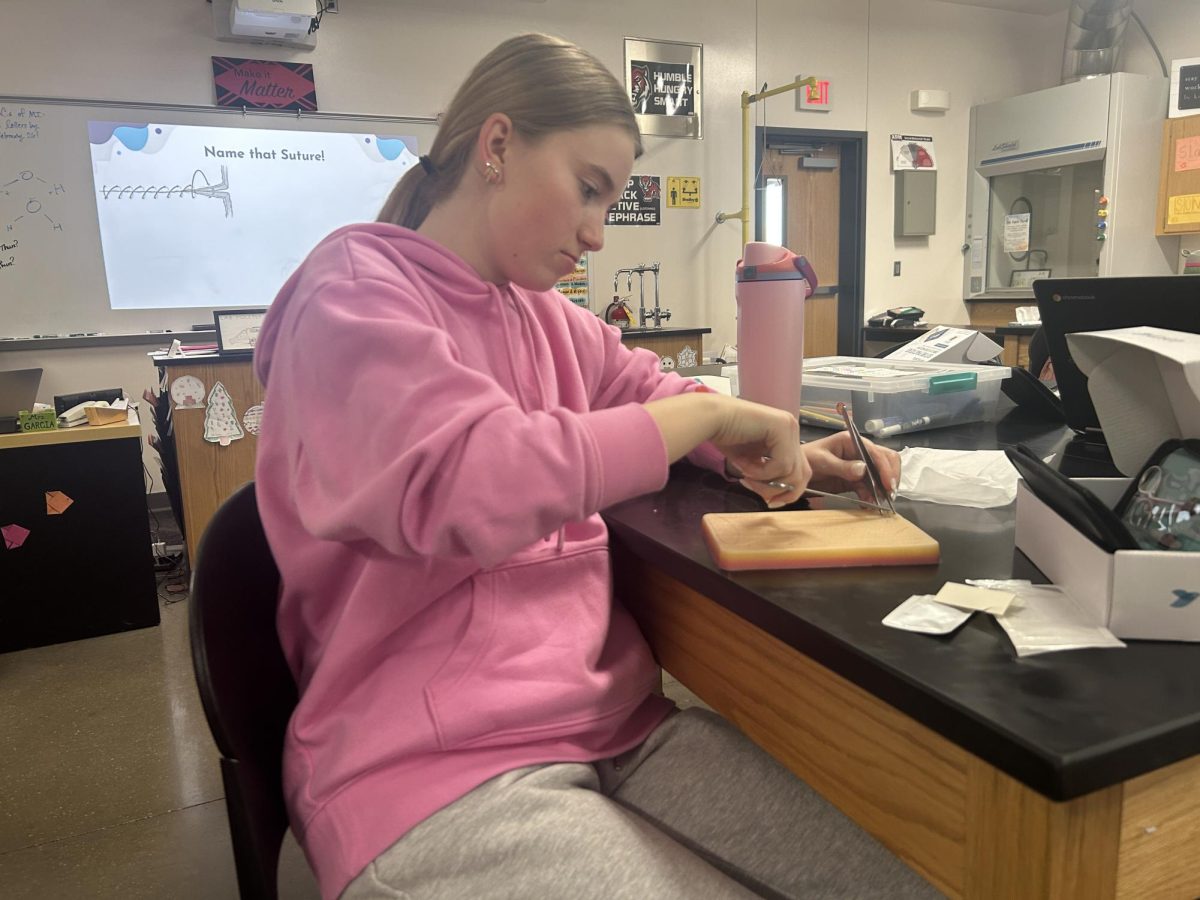

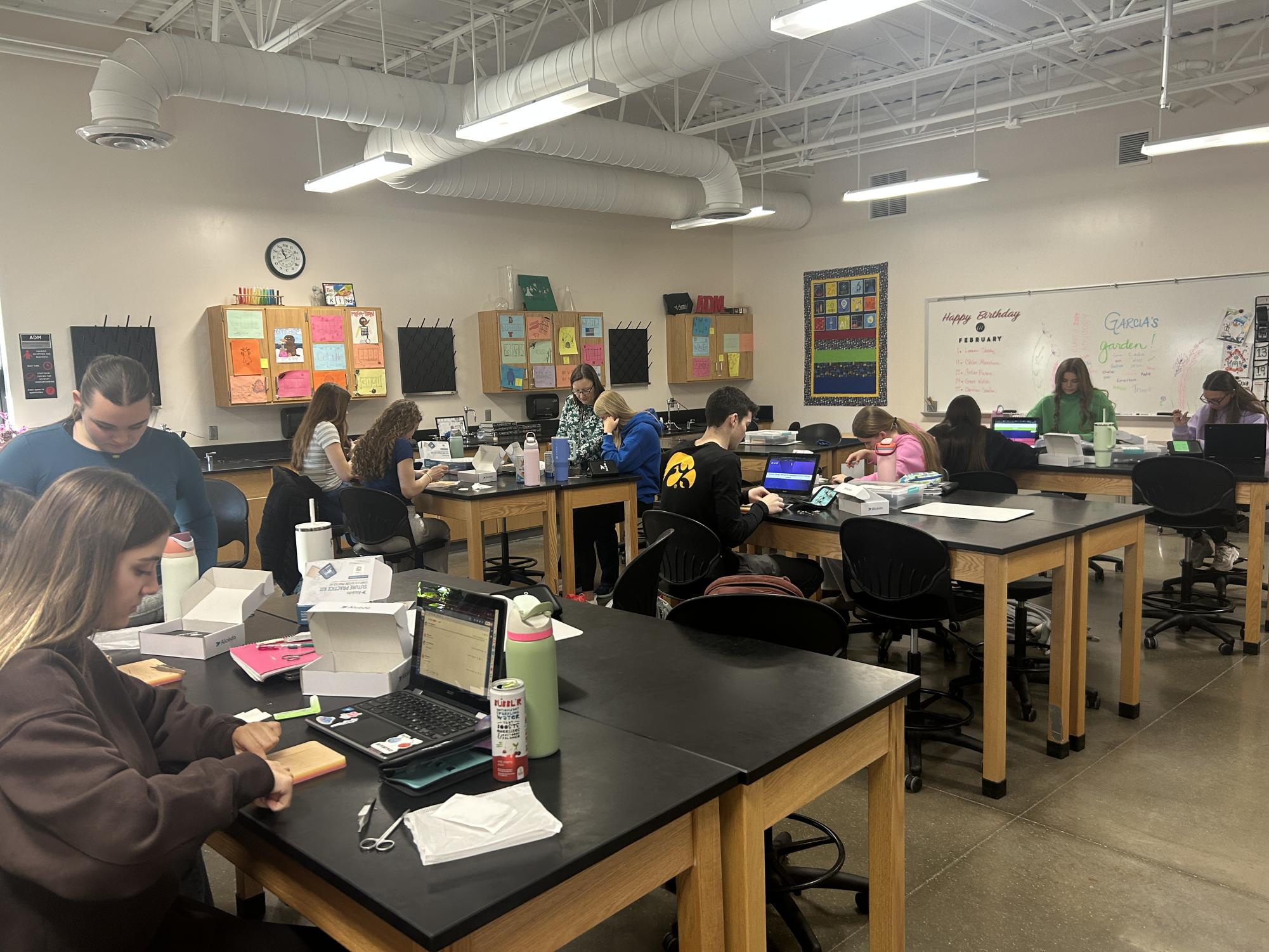
This month, as students finalize their schedules for the upcoming school year, they’ll find many course options to choose from. One of these, often overlooked, is the three-year Project Lead The Way (PLTW) Biomedical Science program that has been available to all students at ADM High School for the past 13 years. It consists of three year-long classes: Principles of Biomedical Science, Human Body Systems, and Medical Interventions.
PLTW is a non-profit national organization that has spent the last 28 years striving to equip students with career readiness and transferable skills that they’ll use beyond the confines of high school. The organization’s website states, “At PLTW, we believe all students–beginning at a young age–need access to real-world, career-connected learning experiences.” With that, the institution offers a variety of courses for students of all ages, with the material ranging from kindergarten through 12th grade in difficulty level. ADM High School offers two of these programs, Engineering and Biomedical Science, and now, we’ll work to unpack the latter of the two.
To start, Sarah Boesen, who teaches ADM’s Earth and Space Science class as well as Human Body Systems, gave an overview of the program.
“I would say we’re close to having 80 kids total between the three classes, and that’s probably pretty consistent each year,” Boesen said. “For all three courses, the basics are to get some understanding for students who are maybe interested in going into something medically related.”
As for course rigor, the program is generally considered to be more challenging than typical high school classes, but still manageable, even in a packed schedule.
“I would say it’s more akin to a DMACC online class as far as difficulty level,” Boesen said. “Some people just have more of an aptitude for understanding those things too.”
That being said, throughout the three years, students dive into lots of advanced, challenging material and helpful concepts that are necessary to know when pursuing a medical career. Max Marple, a junior at ADM who wants to go into a career in nursing, shared what he’s learned from the classes.
“What we’ve learned is mainly about the inner functions of how the body works. So a lot of it is like bones, parts of the body, how cells organize themselves, how they build each other, and things like that,” Marple said. “Some of my favorite parts have been about the bones and organs of the body; that makes it really interesting.”
When asked what he thought of PLTW preparing him to move forward with nursing, Marple shared his honest opinion.
“I think some of it does [prepare you] because it’s a good basis of your understanding. I assume nursing school will be about how to do the actions, but before you do the actions, you want to know why and how they work, so I think, in that sense, it really prepares you,” Marple said.
Additionally, Marple commented on how taking the course helped him decide on a career and that’s why he encourages young students to try it out.
“I took it my freshman year, just because I didn’t know what I wanted to do, and that showed me that I really wanted to do nursing,” Marple said. “So I think it’s something you might as well take.”
Another student who has been greatly impacted by taking the PLTW Biomedical Science courses is Ella Gonnering. Gonnering, like Marple, is a junior who was able to decide on a career as a result of being in the PLTW classes.
“These classes can give you a really good idea of what you want to do and what you’re interested in. I know a lot of people who have decided on a career during high school because of these classes,” Gonnering said. “For me, recently, in Medical Interventions, we were talking about pregnancies and birth stories, and that’s just my cup of tea. I kind of knew that’s what I wanted to do before then, but it was just really reaffirming.”
Gonnering has aspirations to become a labor and delivery nurse, and she’s currently working to get her CNA at the DMACC Perry VanKirk Center. With that, Gonnering discussed how taking the PLTW biomedical classes has given her a leg up in that regard.
“There’s been a lot of times in my CNA class when we’ve been talking about something and I’m like, ‘Oh, yeah, I already know this,’ because I did the PLTW courses,” Gonnering said.
Adding on to that, one of the requirements of earning a CNA is to complete at least 15 hours of job shadowing. Gonnering shared one of her recent experiences with this.
“I actually went to one of the Methodist hospitals where I shadowed a team of labor and delivery nurses, and I got to see one woman fully give a natural birth,” Gonnering said. “It was what I would love to see every single day, which was really clarifying for me to figure out. But yeah, I thought it was amazing. Most people would be grossed out. I went home and told my mom, and she was like, ‘That’s disgusting.’
Another notable benefit that comes with taking part in the PLTW Biomedical Science program is the potential of earning college credit. There has been some confusion among students on how it all transfers, so Boesen clearly explained it.
“Each course through Project Lead the Way has an end-of-course assessment (an EOC). So if a student gets a certain grade in the class for the year and a certain score on the end-of-course assessment, they can qualify to receive college credit,” Boesen said. “If they get a B average in the first two courses, and they receive certain scores on the EOCs, they essentially get credit for what qualifies as Biology 101 plus a lab, so they’re getting four college credits for the two courses; it’s like Principles of Biomed and HBS lumped together. And then MI can sometimes get transferred as an elective credit, but it’s not always as transferable.”
Holly Garcia, one of ADM’s chemistry teachers and the sole Medical Interventions instructor, echoed Boesen’s words while also giving her insights on how college credit plays into the program.
Garcia said, “It used to be that you got one or two credits for each of the three classes, assuming that you passed the end-of-course assessments. They’ve changed it so that now if you pass two of these EOCs out of three, then you get college credit, and instead of it being elective credit, you actually get a general biology credit. But if you’ve passed the first two EOCs, you don’t get extra credits for passing MI. But I still want kids to take MI; I think it’s great content. It’s interesting, and it’s so relevant to our world today.”
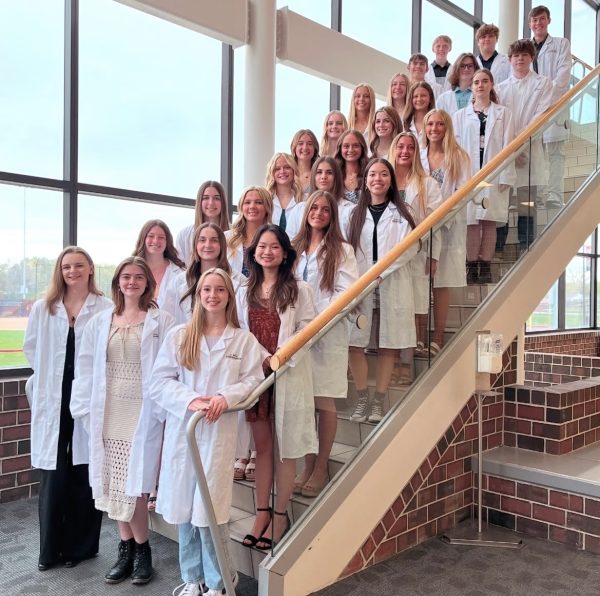
Along with that, Garcia remarked on ADM’s “white coat ceremony,” a special night meant to pay tribute to students’ diligent work throughout the three-year course.
“We just want to celebrate the hard work of our students. It’s a unique program that not a lot of high schools in Iowa have, and so, upon successful completion of the program, we usually do the white coat ceremony in late April or early May,” Garcia said. “We celebrate all they’ve learned, which is above and beyond the science that any other ADM high schooler has learned.”
Garcia continued to go into further detail concerning the white coat ceremony.
“Students get a white coat that’s embroidered with ‘ADM Biomedical,’ and then also their name. We reminisce about their favorite things about biomed and take pictures,” Garcia said. “My favorite thing is to see students displaying their white coats at their graduation reception because they’re proud of earning it, and are maybe more prepared for college because of taking these extra classes.”
Garcia ended with recommending the PLTW Biomedical Science classes to anyone who’s interested in pursuing a career in the medical field.
“I think definitely taking your regular science classes is important, but there’s so many more skills and career explorations that are done in the biomedical classes,” Garcia said. “It really prepares you for potential CNA classes or for your first year of college in a medical field.”
Furthermore, Boesen repeatedly pointed out the prominent role that the PLTW Biomedical Science class can have in helping students find their passion and narrow down their career choices.
“You know, I think if any student really has some interest in the medical field, it’s a good introduction to some of the different things that they could do. Sometimes we have kids come in and say, ‘Oh, I want to be this when I grow up,’ and then they take the course and they’re like, ‘Actually, that’s not what I want to be.’
Like everyone else interviewed, Boesen urges students to just try out the Biomedical Science program as a form of career exploration, if nothing else.
“You might as well try it and find out if you really want to be what you think you do,” she said.