

President Franklin D. Roosevelt once said, “Nobody will ever deprive the American people of the right to vote except the American people themselves—and the only way they could do this is by not voting.”
According to the U.S. Census Bureau, turnout among eligible voters peaked at over 65% in the 1960s but has often fallen below 60% in recent elections. In local elections, turnout is usually below 25%, meaning that only a small portion of citizens decide the leadership for entire communities.
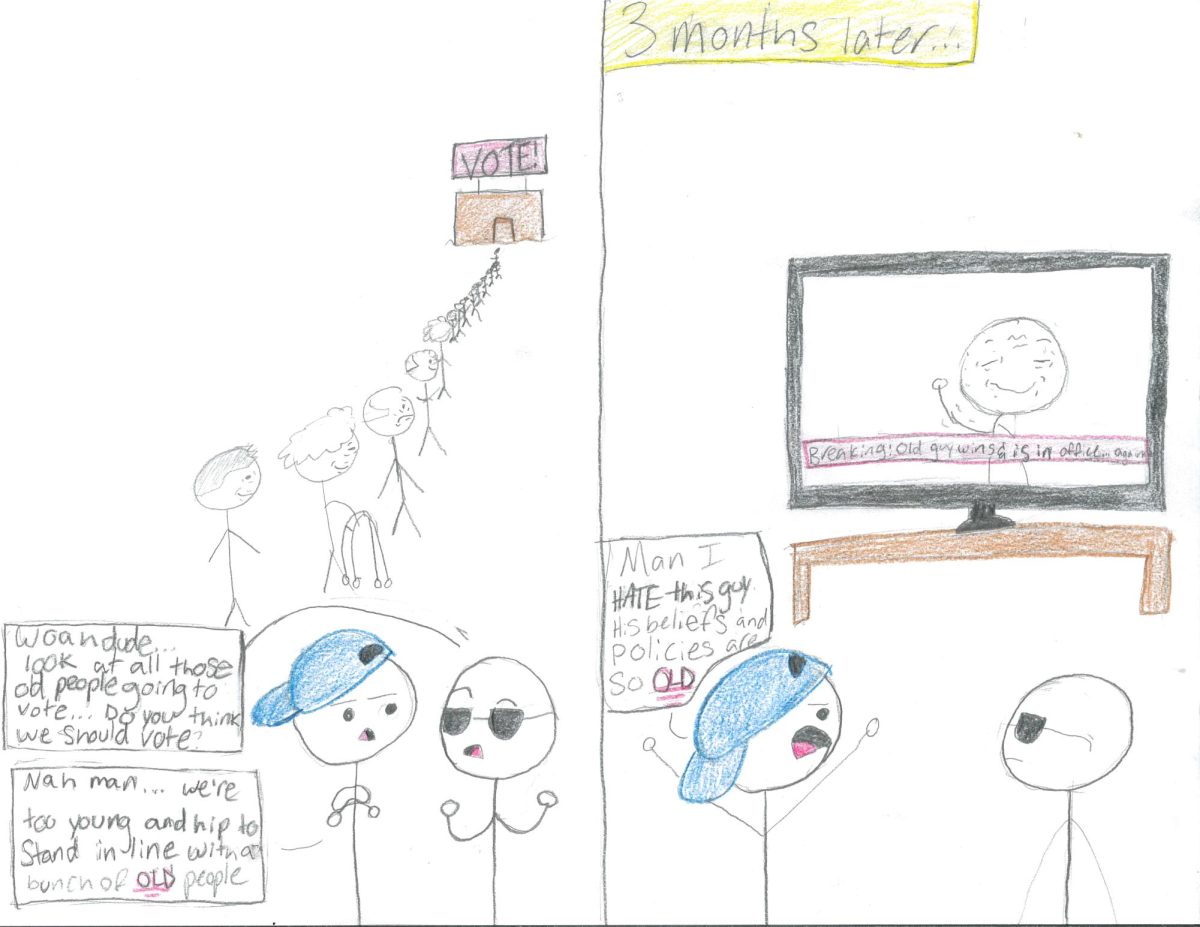
According to data from the Center of American Women and Politics, in the 2024 election, people aged 18-24 have the lowest voter turnout, with only 51.3% of women and 44.2% of men in that age group. This shows a significant challenge in getting younger voters.
In contrast, the age group with the highest levels of voter engagement is people aged 65-74, where 75.7% of women and 74.6% of men vote. This difference in turnout rates shows a considerable gap between younger and older voters.
Despite being the younger generation, it is crucial to recognize that the youth holds substantial potential for influence; however, the lack of active participation indicates a need for greater engagement among young voters. It is vital for this demographic to understand their power in the electoral process and to take steps towards exercising it.
The Declaration of Independence says that governments derive “their just powers from the consent of the governed.” This concept shows the importance of the people’s role in shaping their own government. This consent is not just agreeing passively; it is shown actively through voting. Voting serves as our direct voice in determining how our nation is governed, allowing us to have a say in the laws, policies, and leadership that affect us. Through this, we participate in voting, influencing the direction of our society, and ensuring that our collective values and priorities are reflected in government actions. That consent is given through the act of voting, it’s our direct voice in how the nation is run.
Over time, voting rights were expanded to include all citizens, reflecting the Founders’ commitment to liberty and equality. The 15th, 19th, and 26th Amendments extended voting rights to all races, women, and citizens 18 and older. Each of these milestones reinforced the Founding Fathers’ belief that every voice matters. This means that we shouldn’t take these amendments for granted; many of the US citizens who came before us fought hard so that we can all vote today. It is our duty as the younger population to respect their fight and sacrifice by voting.
When voter turnout is low, it affects the strength of our democracy. Elected officials end up representing only a small part of the population, which affects the overall democratic process. This lack of participation can lead to certain groups being overrepresented, meaning their interests and concerns receive more attention and priority. Groups that do not participate as much may find their voices marginalized and their needs overlooked. This imbalance can result in policies and decisions that do not reflect the broader population’s views, undermining the foundational principle that democracy should represent all citizens fairly and equitably.
When more citizens vote, the results better reflect the nation’s diversity and values. High turnout ensures that leaders are chosen by a larger section of America, not just a small group. Policies are more balanced when they represent the views of all people, not just a few. Voting creates accountability and drives progress. Elected officials are more likely to act in the public’s best interest when more people are watching and voting. Consistent participation strengthens democracy by keeping leaders responsive to their constituents.
Iowa’s next election is scheduled for November 3, 2026. This is a midterm election, during which voters will select candidates for several key positions. For Governor, the candidates are Democrat Rob Sand and Republican Randy Feenstra. For Attorney General, the candidates are Democrat Nate Willems and Republican Brenna Bird. In Iowa’s 3rd Congressional District, the Democratic candidates include Lanon Baccam, Xavier Carrigan, Jennifer Konfrst, Tracy Limon, Sarah Trone Garriott, and Easton Wolfe, while the Republican candidate is Zach Nunn. Begin to inform yourself so you can be ready to vote.
So, the next time an election comes around, stand up, show up, and make your voice heard, because democracy only works when we do.


