

If you’re in high school, or if you’ve been around any school-aged kid, you’ve more than likely heard someone say “six-seven,” and seen them throw up their arms and wave them up and down like they’re throwing a hot potato back and fourth. 67 has been on the rise all year, and dictionary.com finally named it the 2025 Word of the Year in late October. The selection of 67 to be Word of the Year seems sort of odd in comparison to previous words selected.
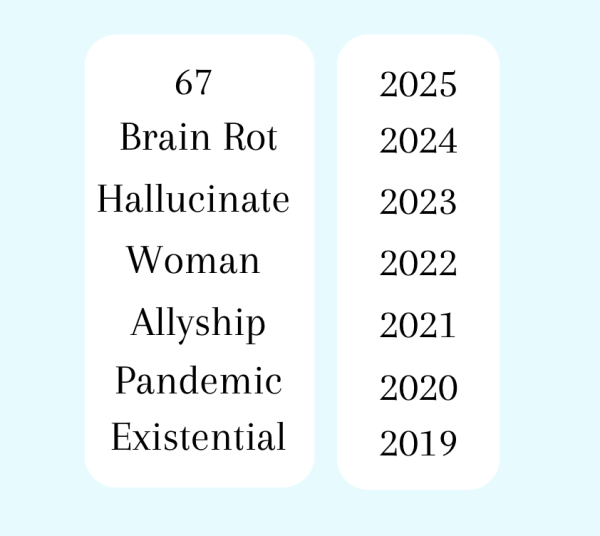
As depicted, words before last year were not considered slang words. They were words that were important or prevalent to the year that came and went, yet for some reason, there was a shift.
Researchers for Dictionary.com use news headlines, social media trends, search engine data, and more to find words that made a dent in conversations all around during the year. 67 was their top result in all of these categories combined. They have used this same method since they began naming Word of the Year in 2010 with the word change.
English teachers at ADM are both concerned and some are frustrated with the selection of this year’s Word of the Year. No teacher was shocked by the selection, but rather confused with how it is selected.
Speech coach and English teacher Emma Bedard was asked if she thought that 67 being crowned word of the year was odd. “It didn’t surprise me. I don’t think it shocked me at all. [67] was so culturally significant, and you could see it in my classroom as well as many others,” Bedard said. “With social media being the main form of communication among younger generations worldwide, I think that it makes a lot of sense.”
According to Dictionary.com, “the most defining feature of 67 is that it’s impossible to define. It’s meaningless, ubiquitous, and nonsensical. In other words, it has all the hallmarks of brainrot.” This reaffirms Bedard’s statement that it genuinely does mean nothing.
Molly Longman, an English teacher, was upset when she heard 67 was given Word of the Year.
Fellow English teacher Sydney Landin shared a similar disappointment. In an interview, Landin was informed of the word of the year, to which her immediate response was, “How? Those are just numbers together. It wouldn’t have been something more dramatic?” Landin said. “Last year’s word was brain rot, and that at least had something to it, but 67 is actually the brain rot.”
Bedard, on the other hand, felt more perplexed as she said, “The word of the year always falls into the culturally significant words that shape our society and our kids… and things that just have a large impact. To my knowledge, that phrase [67] means literally nothing. It’s just a phrase,” Bedard said.
Each teacher interviewed shared a similar sentiment that it is a strange word to be chosen. “I usually feel that the word of the year is multigenerational, and this [word] is very pocketed [within younger generations],” Beth Knipper said. Many teachers feel that this word is a slight misrepresentation of 2025, and they think it should be a word with a wider scope and understanding.
English teacher Natalie Johnson feels similarly, stating “I wish that they picked words that are more encompassing of how our world is.”
Online, this has sparked some controversy, with people arguing that the Word of the Year should have to mean something, while others argue that the way that linguistics unfold is being fairly represented through the selection of 67. When arguing that this phrase means nothing, it simply doesn’t make sense how it could be word of the year, yet when measured by significance and spread of the word, it’s undeniable that it is everywhere.
ABCNewslive posted a TikTok announcing the Word of the Year, and the comments are very expressive of their distaste for the decision. Some examples of comments seen are “67 has NO meaning ITS JUST BRAINROT” by woahisdatae, “i lost all respect for dictionary.com” by ronnyvm, and “The word of the year is a number? I’m concerned about those who make dictionaries” by ckl314159.
There a healthy share of uncertainty, disbelief and frustration around this selection on social media, but among ADM English teachers there is much less hate towards it.
Teachers at ADM have leaned into the joke in their classrooms, some trying to see if students are paying attention, others making it cringe so students will stray away. Teachers don’t have a negative feeling towards 67, but rather see it as an odd phrase that really means nothing. The overall feeling of 67 being titled Word of the Year is confusion. Teachers find themselves considering the criteria needed to name the Word of the Year, yet there is also a realm of understanding, as it is undeniably everywhere among young people.


