

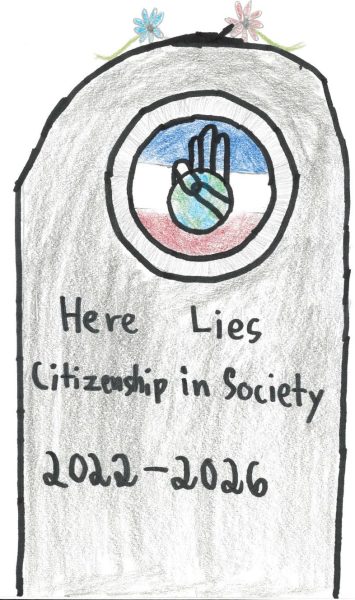
In a February address, United States Secretary of War Pete Hegseth gave Scouting America (formerly Scouts BSA, formerly Boy Scouts of America) an ultimatum. They were to replace the ‘Citizenship in Society’ merit badge with a military-based merit badge and dissolve the program’s DEI board. If they didn’t? The military would cut its ties with Scouting.
Hegseth claimed that “The Boy Scouts lost their way, and a once-great organization became gravely wounded.”
As evidence, Hegseth cited Scouting’s 2019 change to the inclusion of girls, as well as its decline in membership from 10 million in 1970 to less than one million today. This is a loaded situation, so I’d like to examine it piece-by-piece.
Citizenship in Society
What does the Citizenship in Society merit badge entail, anyway? A peek at the requirements tells that the basis of the badge is ethical decision-making, connecting with people who are different from you, all with a focus on leadership. Alone, that makes a great badge that I hope few would find issue with. Ethics should guide everyone’s daily decisions, and the badge prompted scouts to define what they think is ethical, not asking for a certain viewpoint.
There was, however, another part of that badge that undoubtedly led to its removal. And that was the focus on diversity, equity and inclusion, or DEI. Those three fateful words were featured thrice among the wording of the badge requirements. DEI has been a hot-button topic lately, and Hegseth is openly against it, which is why he killed the badge.
But this article isn’t about DEI. It’s about Scouting. As an Eagle Scout myself, I couldn’t care less about whether DEI was a part of the program or not. It’s had no discernable impact on my experience for the 11 years I’ve been in Scouting. So I’m not going to argue for or against DEI’s inclusion in the badge and organization as a whole.
What I will argue for, however, is Citizenship in Society. This young badge was introduced in 2022, and I earned it the next year. Actually, I had to earn it. Citizenship in Society was part of a select group of fourteen merit badges that each scout must earn if they wish to achieve the highest rank of Eagle.
Citizenship in Society was about loving and accepting everyone as the people that they were. Not seeing them for their creed, their race, or their thoughts about the world, but seeing them as human. That principle can — and always has — existed independently of DEI.
The badge should have been given a chance at reform. DEI is clearly a non-negotiable to Hegseth, but the rest of the badge wasn’t. By very slightly altering requirement one, cutting requirement seven and changing some of requirement 11, Citizenship in Society could have been close to the same badge it’s always been, but without any mention of DEI.
Aidan Hearn is a scout, somewhere in the Nation. I truthfully don’t know anything about him, but he had something to say about Citizenship in Society.
“Cit in Society, in my eyes, was basically just how to be a good person in the community”, Hearn shared in an Instagram comment. “However simple that may sound, I do think we need it in this day and age. Too many examples of people acting terribly to other people, and since scouts are supposed to be upstanding citizens, I definitely think it should be added back”.
There’s three other citizenship badges (in the community, nation and world, respectively) along with dozens of other requirements, ranks and awards. I hope that Scouting America will use one of these to roll some of the ethical leadership ideals of the late badge into another part of the organization.
Girls
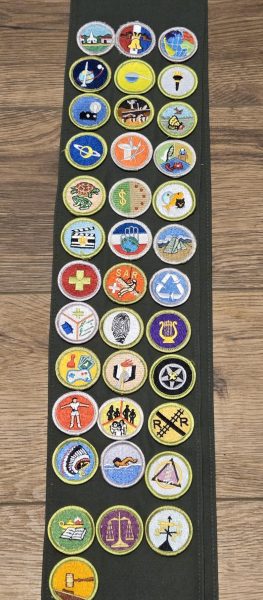
Since 2019, girls have been a part of what was once known as Boy Scouts. Believe me, I was once mad about this change too. The difference? Pete Hegseth is the 45 year-old Secretary of War. I was nine, and quickly got over myself.
Not being a girl myself, I cannot speak for the girls in Scouting America, so I spoke with someone who can. Claudia Murphy is an Iowa Eagle Scout, and somewhat of a living-legend in Central Iowa Scouting.
“When I was in elementary school there wasn’t a Girl Scout troop for my grade so unfortunately it wasn’t an option. I did tag along with my sister and her troop for functions,” Murphy said. “My father is an Eagle Scout and he has his badges on display in our house so when Scouting America announced that girls could join he was very excited about the possibility of me joining. We are a very outdoorsy family so joining Scouting America was a logical step for us.”
There clearly was a need to allow girls into Scouting America, as over 150,000 girls are currently part of the organization, per Scouting America.
Girls and boys in Scouting America usually spend the vast majority of their time completely separated. The majority of troops are (except for the adult leadership) either full-male or full-female. The only times the two genders interact is summer camp and larger, council events.
There is a small number of co-ed troops, but those are generally only present in communities with little participation in which a combined troop is the only way one could reasonably exist.
It’s worth noting that The Order of The Arrow (OA), a selective Scouting Society, does activities with girls and boys together. But those activities are typically once a month (as opposed to weekly troop activities) and few scouts ever reach The OA.
So, in other words, the boys often don’t even notice that girls are a part of the organization, while the girls — like Murphy — who want to be a part of Scouting America are immensely grateful that they can be.
The Military
Scouting and the military have had a longtime connection, with the military providing funding that keeps the organization afloat. Without charging ludicrous amounts of money as a requirement for membership, the military’s cash is Scouting’s lifeline.
So, when Hegseth threatened to cut military ties with Scouting America, he was in essence threatening the organization as a whole.
As for the to-be-released Military Service merit badge, I don’t see any reason why it shouldn’t be offered. It will — unlike Citizenship in Society — be a completely optional addition to the catalog of over 135 merit badges.
Decline in Membership

(Photo by Caleb Klassen)
Sadly, Hegseth is right. Scouting just isn’t as popular as it used to be. But I’m pretty sure that people aren’t boycotting Scouting because there’s a troop of girls meeting the next town over and DEI is mentioned three times in one badge. I think the decline is just a consequence of modern life and a few missteps along the way.
It does cost a substantial amount of money to be a part of Scouting, even with military support. For the average scout, yearly dues are $85, plus $25 per campout (usually once a month), $400 for summer camp and recommended additional gear costs.
Now, much of that cost can be reduced by working with the troop on fundraising events, but that takes a lot of time and effort and can still leave a sum to be paid out-of-pocket. The availability of such events can also vary. For scouts in Adel’s Troop 152-B, fundraising — if done devoutly — can pay for most of Scouting’s bill.
From 2019 to 2020, Scouting membership cut in half from about two million to one million. This was for two primary reasons: The Church of Jesus Christ of Latter-Day Saints (LDS) and COVID-19.
For over one hundred years, The LDS Church strongly encouraged all of its young boys to participate in Scouting America, along with providing support by ‘chartering’ many troops. However, in 2019, they removed support, citing “the need to create and implement a uniform youth leadership and development program that serves its members globally.”
That same year, COVID-19 began to pop up, and –as we all know — it effectively shut the world down in March of 2020. I remember what Scouting was like during the pandemic: meetings were few and far between, activities were awkwardly done six feet apart and merit badge classes became tedious and oh-so-boring Zoom meetings. In this landscape, it was common for youth to want to quit, and easy for parents to agree.
Unfortunately, Scouting America has also been plagued with allegations of sexual misconduct in recent years. Thousands of people have come forward with claims that horrible things were done to them by Scouting leaders.
Scouting America has done its best to combat this through background checks, required youth education and yearly training for all registered adults. But ultimately the organization cannot oversee all 40,000 scouting troops, and any sexual misconduct by leaders is not the fault of — and therefore cannot be fully prevented by — the organization as a whole.
There’s not a single reason membership is on the decline. There’s many factors all contributing to the fall of Scouting, but as the numbers keep shrinking and summer camp gets emptier, Scouting America relies more on the aforementioned military funding and lies at the whims of Hegseth.
Let Scouting Find Its Way
I’d like to revisit those words Hegseth used to describe the current state of Scouting. “The Boy Scouts lost their way, and a once-great organization became gravely wounded.” This once-great organization really is gravely wounded. Not by DEI or girls, but by controlled funding affecting their independence and a decline in membership they cannot control.
Hegseth claimed that Scouting has lost its way, but that’s just a consequence of pointing someone in the wrong direction. If Scouting America has lost its way, then Hegseth must let them find it. Not by enforcing increased control on the organization, but by loosening control and letting Scouts do what Scouts do best: Lead.
Lead Scouting out of the membership slump. Lead Scouting to become an organization so financially sound that they may become independent of outside funding. Lead Scouting to — as the Scout Oath reads — be physically strong, mentally awake and morally straight.


